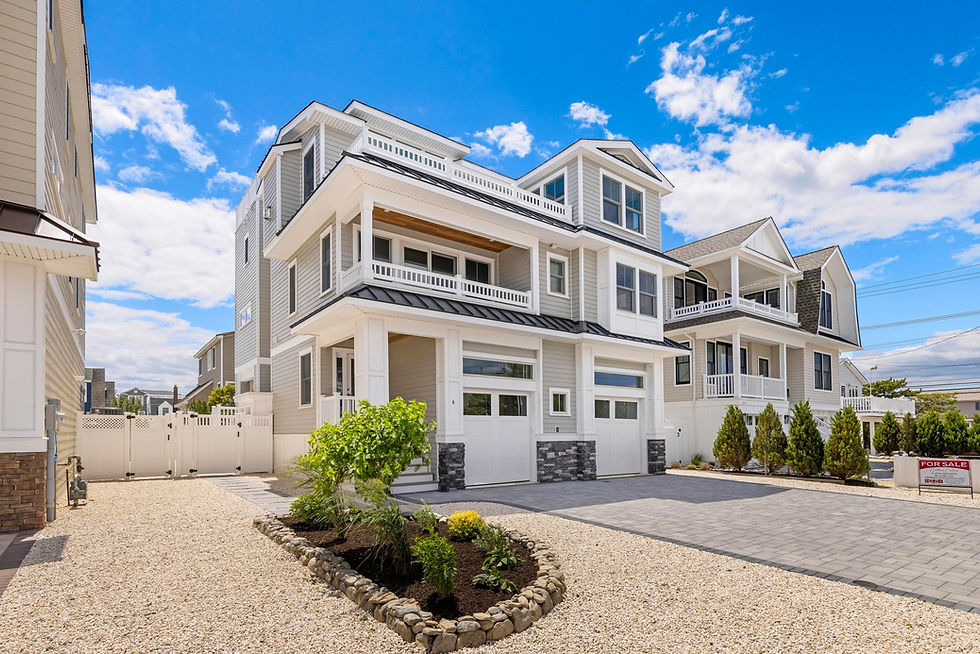



Financing a Multifamily Property in the LBI Real Estate Market
Financing a Multifamily Property in the LBI Real Estate Market: What Buyers Need to Know
Learn how to finance multifamily properties in the LBI real estate market, including DSCR loans, house hacking, agency financing, and common mistakes.

The Long Beach Island (LBI) real estate market continues to attract investors looking for strong rental income, long-term appreciation, and the opportunity to own property in one of New Jersey's most desirable coastal destinations. While single-family homes dominate much of the LBI housing market, multifamily properties—including duplexes, triplexes, and four-unit buildings—offer unique opportunities for cash flow, vacation rentals, and wealth building.
However, financing a multifamily property or duplex in the Long Beach Island real estate market differs significantly from obtaining a mortgage on a traditional single-family home. Understanding how lenders evaluate these investments can help buyers secure better financing terms and avoid costly mistakes.
By: Nathan Colmer | LBI Real Estate Agent | The Van Dyk Group
Cell: 609-290-4293 | Office: 800-222-0131 | ncolmer@vandykgroup.com
How Does Financing Differ Between a Single-Family Home and a Multifamily Home?
Financing a multifamily property is generally more complex because lenders evaluate both the borrower and the property's ability to generate income. With a single-family home, approval is primarily based on the borrower's personal income, debt-to-income ratio, credit score, and assets. For multifamily properties in the LBI real estate market, lenders also analyze rental income, occupancy rates, operating expenses, and the property's overall financial performance. As the number of units increases, lenders place more emphasis on the property's cash flow rather than solely on the borrower's personal finances. Multifamily loans often require larger down payments, more cash reserves, and additional documentation compared to owner-occupied single-family mortgages.
Important points to consider:
Multifamily financing focuses on both borrower and property performance.
Rental income plays a major role in loan approval.
Down payment requirements are often higher.
Documentation and underwriting are typically more extensive.
When Should a Borrower Use an Agency (Fannie/Freddie/HUD) Loan vs. a Bank, Bridge, or Construction Loan?
The best financing option depends on the investor's goals, timeline, and property condition. Agency loans from Fannie Mae and Freddie Mac are ideal for stabilized multifamily properties with consistent occupancy and strong financial performance because they typically offer lower rates and longer terms. HUD loans can provide excellent long-term financing for larger properties but often involve a lengthy approval process. Bank loans may be preferable for smaller multifamily properties, local investors, or situations requiring flexibility. Bridge loans are commonly used for properties needing renovations or repositioning before permanent financing is available. Construction loans are specifically designed for ground-up development or major redevelopment projects and usually convert to permanent financing upon completion. In LBI, investors purchasing older multifamily properties for renovation frequently use bridge financing before transitioning into long-term agency debt.
Important points to consider:
Agency loans work best for stabilized income-producing properties.
Bank loans offer flexibility and local decision-making.
Bridge loans help finance value-add opportunities.
Construction loans support new development and major renovations.
Loan selection should align with the property's business plan.
What Are the Biggest Mistakes People Make Financing Their First Multifamily Deal?
Many first-time multifamily investors underestimate the amount of cash needed beyond the down payment. In addition to closing costs, lenders often require reserve funds for maintenance, vacancies, insurance increases, and unexpected repairs. Another common mistake is overestimating rental income while underestimating operating expenses, resulting in unrealistic projections that can strain cash flow after closing. New investors also frequently focus solely on interest rates rather than overall loan structure, prepayment penalties, reserve requirements, and lender flexibility. In LBI's seasonal rental market, buyers must carefully evaluate whether projected rental income is supported by historical performance rather than optimistic assumptions.
Important points to consider:
Budget for reserves beyond the down payment.
Use realistic rent and expense projections.
Review the entire loan structure, not just the interest rate.
Analyze historical rental performance carefully.
Plan for vacancies and unexpected expenses.
How Does DSCR / NOI Underwriting Actually Work for Apartment Buildings—What Numbers Do Lenders Want to See?
Debt Service Coverage Ratio (DSCR) and Net Operating Income (NOI) are two of the most important metrics lenders use when evaluating multifamily properties. NOI represents the property's income after operating expenses but before mortgage payments. Lenders compare NOI to the property's annual debt payments to calculate DSCR. A DSCR of 1.25 generally means the property produces 25% more income than is required to cover its mortgage obligations. While requirements vary by lender and market conditions, many multifamily lenders prefer DSCR ratios of at least 1.20 to 1.30. They also examine occupancy history, rent rolls, property taxes, insurance costs, and operating expenses to ensure the income is sustainable. In a market like LBI, lenders may pay particular attention to the consistency and reliability of seasonal rental income.
Important points to consider:
NOI equals income minus operating expenses.
DSCR measures the property's ability to pay its debt.
Most lenders target a DSCR of 1.20–1.30 or higher.
Lenders analyze occupancy, expenses, and rent history.
Strong, stable cash flow improves loan terms.
How Can Someone House-Hack a Small (2–4 Unit) Multifamily with Little Money Down, and What Do Lenders Look For?
House hacking remains one of the most effective ways to enter the multifamily market, particularly with a two-to-four-unit property. This makes buying a duplex in the LBI real estate market a possibility for many potential buyers. By occupying one unit as a primary residence, borrowers may qualify for conventional owner-occupied financing with significantly lower down payment requirements than investment-property loans. Some loan programs allow down payments as low as 3% to 5% for qualified borrowers. Lenders typically evaluate credit score, employment history, debt-to-income ratio, available reserves, and the anticipated rental income from the other units. In many cases, a portion of the projected rental income can be used to help the borrower qualify. For buyers seeking entry into the LBI multifamily market, house hacking can provide the dual benefit of reducing housing costs while building equity and rental income.
Important points to consider:
Live in one unit and rent the others.
Lower down payments may be available for owner-occupied properties.
Rental income can help borrowers qualify.
Strong credit and stable income improve financing options.
House hacking can accelerate wealth-building and cash flow.
Multifamily Financing in the LBI Real Estate Market
Multifamily properties can be powerful investment vehicles in the Long Beach Island real estate market, offering opportunities for rental income, appreciation, and long-term wealth creation. Understanding the options to finance these types of multi-family investments is essential to this opportunity's success. Whether you're purchasing a duplex to house hack, acquiring a vacation rental investment, or building a larger portfolio, understanding financing options is essential. By choosing the right loan structure, maintaining adequate reserves, and understanding key underwriting metrics such as NOI and DSCR, investors can position themselves for long-term success in one of New Jersey's most sought-after coastal real estate markets.
Buying or selling on Long Beach Island is different from anywhere else, and having the right guidance matters with such a significant investment. I'm Nathan Colmer, a local LBI real estate agent with over 20 years of experience helping buyers and sellers make informed decisions, especially when it comes to second homes and investment properties.
As both a real estate professional and an active investor in the LBI real estate market, I offer insight beyond listing details. Whether you're looking for a vacation home, exploring investment options, or ready to list your property, I take a personalized, hands-on approach to help you navigate the process with confidence.
By: Nathan Colmer | LBI Real Estate Agent | The Van Dyk Group
Cell: 609-290-4293 | Office: 800-222-0131 | ncolmer@vandykgroup.com